Liquidation

Liquidation occurs when a trader’s collateral is no longer sufficient to cover their leveraged position’s losses, triggering an automated forced closure by the exchange's liquidation engine. It is a critical risk-management mechanism that ensures the solvency of lending protocols and derivative platforms. In 2026, the focus has moved toward MEV-resistant liquidation models that protect users from predatory "cascades." This tag provides essential information on maintenance margins, health factors, and how to avoid liquidation in high-volatility environments.

15090 Articles
Created: 2026/02/02 18:52
Updated: 2026/02/02 18:52
what it means for spreads, taxes and flows

what it means for spreads, taxes and flows

The post what it means for spreads, taxes and flows appeared on BitcoinEthereumNews.com. The largest Bitcoin ETF in the world has just revamped its process for moving coins in and out of the fund. BlackRock’s IBIT, which has accrued more than $20 billion since launch, can now process creations and redemptions “in kind.” The SEC’s approval order quietly flipped the switch: IBIT’s authorized participants can now swap Bitcoin directly against shares instead of only taking or delivering cash. While it might sound like a small operating change, the effects could be anything but minor. When spot ETFs went live in January 2024, the SEC required them to be created in cash. If you wanted to buy IBIT, an authorized participant (AP) like Citadel or UBS would sell you ETF shares and wire cash to Coinbase to source the actual Bitcoin. Redemptions worked the same way in reverse: sell ETF shares, get dollars back, and Coinbase liquidated coins to cover the difference. However, this model created a drag. Every creation and redemption process runs through a fiat leg, accumulating transaction costs, custody fees, and, most importantly, tax frictions. APs couldn’t simply shift Bitcoin in inventory: they had to finalize cash sales. That widened bid-ask spreads for large players and opened the door to tracking errors between IBIT’s share price and Bitcoin. In-kind solves this. Now, if an AP needs to deliver 1,000 BTC worth of IBIT shares, it can simply transfer 1,000 BTC from its own balance. Redeeming works the same way: return IBIT shares, receive coins directly, and no forced liquidation. Not everyone can do this. The SEC’s approval order and updated IBIT prospectus name four firms with the privilege: Jane Street, Virtu Americas, JP Morgan Securities, and Marex. These are the desks that already dominate ETF market-making. They now get to skip a step, moving Bitcoin in and out of IBIT’s custodian wallet…

Author: BitcoinEthereumNews
Bitcoin Price Analysis: Short Traders Bet $1.4B Against BTC as JD Vance Hints US Govt Shutdown

Bitcoin Price Analysis: Short Traders Bet $1.4B Against BTC as JD Vance Hints US Govt Shutdown

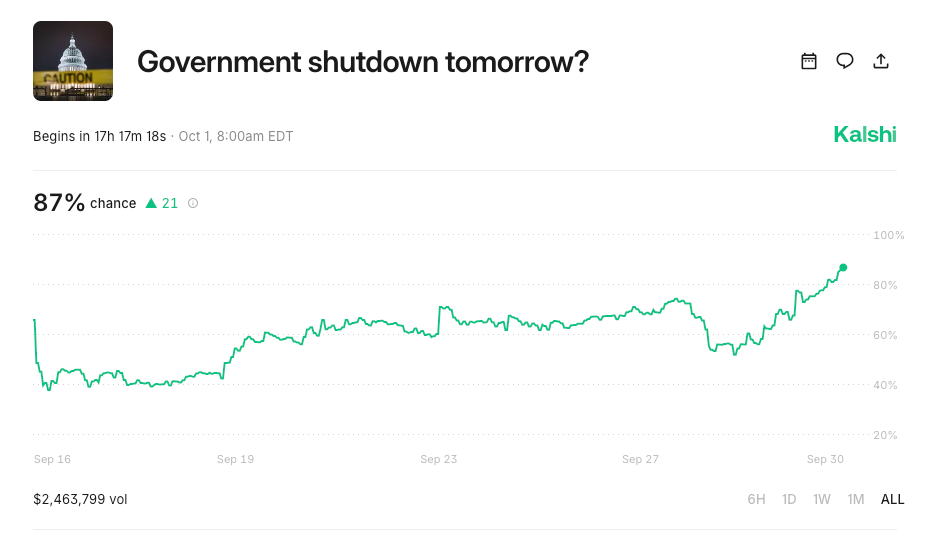
VP J.D. Vance hints at the first US government shutdown in seven years, with prediction markets showing 87% likelihood as lawmakers remain deadlocked on spending. The post Bitcoin Price Analysis: Short Traders Bet $1.4B Against BTC as JD Vance Hints US Govt Shutdown appeared first on Coinspeaker.

Author: Coinspeaker
Ethereum Sees $547M Inflows but On-Chain Activity Declines Below $4,200

Ethereum Sees $547M Inflows but On-Chain Activity Declines Below $4,200

TLDR Ethereum saw $547M in ETF inflows, signaling strong TradFi positioning. BitMine Immersion expanded ETH holdings to $10.6 billion, aiming for 5%. Ethereum’s on-chain activity dropped 12% in the last 30 days. ETH could face liquidation risks for $1 billion in short positions at $4,350. Ether (ETH) has struggled to stay above the $4,200 mark [...] The post Ethereum Sees $547M Inflows but On-Chain Activity Declines Below $4,200 appeared first on CoinCentral.

Author: Coincentral
DeFi Saver Launches New Protocol Exploration Tool

DeFi Saver Launches New Protocol Exploration Tool

The post DeFi Saver Launches New Protocol Exploration Tool appeared on BitcoinEthereumNews.com. The new Aave DeFi Explore page lets users browse and analyze the most important Aave market metrics and Aave positions across all six currently supported chains. Additionally, the Price slider tool enables users to simulate price changes and observe their impact on specific positions. DeFi Saver has just launched the Aave DeFi Explore page, a comprehensive dashboard designed to keep users up to date with real-time Aave analytics and market changes.  Designed to reduce uncertainty and improve transparency, Aave DeFi Explore aims to provide users with actionable insights by giving them a clearer understanding of the health and activity within the Aave protocol. What is Aave DeFi Explore? DeFi Saver’s Aave DeFi Explore page is a dashboard made to help users stay up to date with Aave market metrics and positions across all six currently supported chains on DeFi Saver: Ethereum Mainnet, Arbitrum, Optimism, Base, Linea, and the recently launched Plasma chain.  Once users access it, they will be met with a live feed of all Aave positions as they’re being opened. By clicking on any of the positions shown, users can view a detailed breakdown that includes key metrics, collateral and debt composition, and full position history, thus making position analysis much easier, accessible, and comprehensive. One highlighted feature users could find especially useful is the Price slider. Once a user clicks on a certain position, they can simulate price oscillations of the collateral and borrowed assets, and assess liquidation risks for the position in question. With that said, the new protocol explorer now allows users to: Access a live feed of the latest transactions and detailed market stats via the Homepage; Research specific chains, their total supply and borrow amounts, as well as the total number of positions on that chain; Check e-modes and supply and borrow details…

Author: BitcoinEthereumNews
2 million users and 10k agents on the AI blockchain

2 million users and 10k agents on the AI blockchain

The post 2 million users and 10k agents on the AI blockchain appeared on BitcoinEthereumNews.com. Over 2 million registered users and 10,000 agents already published. ChainOpera brings decentralized AI from the experimental phase to a concrete implementation on blockchain, with incentives, traceability, and integrated verifications, as described in the official ChainOpera whitepaper and in industry analyses published on The Block. The project, described by co-founder Salman Avestimehr – professor at USC and recipient of the U.S. Presidential Early Career Award for Scientists and Engineers (PECASE), as well as IEEE Fellow – combines decentralized federated learning and distributed ledgers to build an operational and interoperable ecosystem. In this context, the stated goal is to return ownership and control to communities of developers, computing providers, and end users. According to the public data available in the whitepaper and official communications, updated as of September 30, 2025, the platform reports over 2 million registered users and approximately 10,000 published agents. Industry analysts note that the completion of the $17 million seed round in December 2024 accelerated the development of the L1 and OS components. Cross-checks of the technical pages reveal metrics on PoI functionalities and the layered structure that confirm the approach described in the project document. Origins, team, and vision ChainOpera was born from the experience gained with FedML, an open-source library launched in 2019 for decentralized federated learning. The project was co-founded by Salman Avestimehr and Chaoyang Aiden He, who initiated FedML during his PhD FedML ChainOpera. The team includes academic profiles and engineers from UC Berkeley, Stanford, USC, MIT, and companies like Amazon, Google, and Microsoft. The long-term vision converges towards a community-owned and governed “Crypto AGI,” a topic addressed in interviews and debates within the sector The Block. The $17M seed round was announced in December 2024 and saw the participation of institutional investors supporting the development of the L1 infrastructure. What does “decentralized…

Author: BitcoinEthereumNews
Visa tests pre-funding in stablecoin for payments

Visa tests pre-funding in stablecoin for payments

The post Visa tests pre-funding in stablecoin for payments appeared on BitcoinEthereumNews.com. Visa is experimenting with stablecoin pre-funding on Visa Direct to make cross-border payments faster and more predictable. The pilot allows depositing funds in pegged tokens, accounted for by Visa as “money in the bank”: essentially, funds immediately available for global payouts. Announced at SIBOS on September 30, 2025, and described by the specialized press, the initiative involves selected partners and aims to leverage Visa’s global infrastructure that connects over 11 billion eligible cards, accounts, and wallets. Bloomberg has detailed the program and Visa’s official documentation explains the integration logic with the existing network Visa. In a context where the average cost of retail remittances exceeds 6.2% of the amount sent (World Bank), the initiative aims to free up liquidity and simplify operational steps. Updated September 30, 2025. What is pre-funding in stablecoin and why it matters In the traditional model, companies maintain balances in fiat across multiple accounts and jurisdictions to ensure payments. With the pilot, however, prefunding occurs in stablecoin which Visa treats as immediately available funds, reducing the need to lock up capital in multi-currency accounts. This results in greater visibility on balances and, for treasury teams, a more robust control over cash flows. How it works on Visa Direct: from the wallet to the beneficiary The operational flow integrates into existing processes and is structured into a few key phases: Prefunding: the company transfers stablecoin to the operational account linked to Visa Direct. Availability: the funds are immediately usable for payouts. Conversion: at the time of issuance, the stablecoins are converted into local currency through authorized partners. Liquidation: beneficiaries receive in fiat to accounts, cards, or wallets compliant with local regulations. Reconciliation: the reporting provides complete traceability in line with corporate systems. What changes for companies Less capital locked in multi-currency accounts, with more elastic liquidity. Reduction…

Author: BitcoinEthereumNews
Will October Crown Bitcoin Or Break It? Key Levels In Play

Will October Crown Bitcoin Or Break It? Key Levels In Play

Bitcoin enters the final day of the quarter in a tight coil of technicals and macro catalysts, with traders fixated on a handful of levels that will likely set the tone for October. Ostium Research’s week-ahead outlook frames the setup as a fading “window of weakness” into a potential Q4 tailwind, but only if the market navigates an event-heavy calendar without losing critical supports. As author Nik Patel puts it, “weekly momentum is still supportive of higher prices and I believe we are now emerging from the window of weakness I had marked out from Friday 20th Sept.” Key Bitcoin Levels Signal Explosive October Spot price action remains defined by last week’s rejection at the August open near $112,000 and a swift slide into the low-$108,000s before a rebound into Sunday’s close. On the weekly timeframe, momentum still tilts higher, but Patel warns that quarter-end, the October turn, and a dense run of data can stretch volatility. His base case is unambiguous: “I think any dip you get this week is one you want to look at as an opportunity for longs for the remainder of Q4,” he writes, adding that concerns about a cycle top in October are misplaced given “tailwinds into mid-Dec.” The mid-cycle risk marker sits around $99,000, with a longer-term invalidation tied to the 360-day moving average near $97,900. “Unless we lose $99k on a weekly close, nothing here looks mid-term bearish to me,” Patel states. Related Reading: Bitcoin Could Go To Zero, Hedge Fund CEO Warns On the daily chart, the market carved a higher low above roughly $107,000 after the $112,000 rejection, keeping the short-term structure constructive. Patel’s upside trigger is precise: “If we do now push higher off this low through the rest of this week to close back above the August open and trendline resistance up near $115.7k, I think it is very unlikely you see $107k–$108k retested in October.” Conversely, he stresses the downside waypoint in a volatility burst: “I think the lowest we see this week is the 200dMA at $104.6k on a major flush of the lows.” The tactical map he sketches gives bulls and bears something to do, sometimes within the same session. On the long side, he favors fading a stop-hunt under last week’s low or into the September open, “with invalidation on a close below the 360-day moving average, currently at $97.9k, below which we have not closed since March 2023.” If the market squeezes first, he outlines a switch-hitter approach: a sharper rally into the quarterly close that “takes out the $114k high into Oct 1st,” followed by a fade on bearish divergence aiming “for at least $110k, if not $108.5k into the weekend,” where he’s prepared to flip long again. Related Reading: Bitcoin Retail Demand Retreats: 30D Change Falls To Lowest Level Since July Macro complicates an otherwise orderly technical picture. Patel expects the dollar to overextend before rolling over, a sequence that would support risk later in Q4: last week’s post-FOMC dollar bid is “short-lived,” with DXY “99 as the highest I am expecting,” and a larger move toward 93 in Q4 if momentum breaks down beneath the September open. On equities, he anticipates “a little choppier” October than crypto but still frames dips as opportunities into year-end. Positioning and derivatives context backstop the directional view. Patel highlights snapshots across Velo and CoinGlass, three-month annualized basis, and Bitcoin versus altcoin open interest, then overlays expected one-week and one-month liquidation clusters to illustrate where forced flow could accelerate either path. The through-line remains that this week’s volatility is likely the prelude, not the postscript, to Q4. “The opportunity for those lows to be cleaned up should be over the next 5–7 days,” he notes. “If we run last week’s low and then reclaim on the lower timeframes, that could be the October low forming early.” In sum, Bitcoin’s near-term riddle is less about trend decay than the choreography of a shakeout. Above ~$112,000, buyers can press quickly toward the ~$115,700 pivot; beyond that, the all-time-highs narrative returns to center stage. Sweep the lows first and hold the $104,600–$107,000 shelf, and the market may be laying its October floor. Only a weekly close below $99,000 would meaningfully dent the Q4 bull case Patel maps out for readers this week. “You should not get bear-holed,” he writes. “As such, any dip between now and the weekend is where I am expecting the formation of an October low. At press time, BTC traded at $113,248. Featured image created with DALL.E, chart from TradingView.com

Author: NewsBTC
Top Solana (SOL) Alternative That Could Deliver 10x Gains Over SOL in 2025

Top Solana (SOL) Alternative That Could Deliver 10x Gains Over SOL in 2025

As Solana (SOL) continues to be under the spotlight with its speedy blockchain and staking capabilities, investors are increasingly keen on looking at alternatives with more upside potential. Mutuum Finance (MUTM) is rapidly emerging as a standout coin, offering revolutionary DeFi services combining peer-to-peer and pooled lending with dynamic staking rewards. Priced at only $0.035, […]

Author: Cryptopolitan
Crypto Market Slips as U.S. Government Shutdown Looms

Crypto Market Slips as U.S. Government Shutdown Looms

The post Crypto Market Slips as U.S. Government Shutdown Looms appeared on BitcoinEthereumNews.com. Bitcoin and Ethereum retreat alongside broader markets as liquidations spike. The crypto market edged lower on Tuesday, Sept. 30, giving back some of yesterday’s gains as investors weighed macro headwinds, including the risk of a potential U.S. government shutdown. Bitcoin (BTC) is trading around $113,101, down roughly 0.7% on the day. Ethereum (ETH) is hovering near $4,120, declining about 1.1% over the past 24 hours, according to data from The Defiant’s price page. BTC Chart Among major altcoins, Solana slipped 2.2% to $205 and XRP eased 2.3% to $2.83. BNB is down 1.3% to $998, while TRON fell 0.8% to $0.33. Elsewhere, Monero’s XMR jumped 2.3% to $292, while Plasma’s XPL dropped nearly 22% to $0.90. Overall, the total crypto market capitalization decreased by 1% over the past day to $3.96 trillion, with Bitcoin dominance at 57% and Ethereum at 12.6%. Liquidations, ETFs, and Investment Products In the past 24 hours, nearly $354 million in crypto positions were liquidated, per Coinglass data, with longs accounting for around $227 million and shorts making up around $127 million. Ethereum led with nearly $79 million in liquidations, followed by XPL at around $50 million, while BTC accounted for approximately $43 million. Spot Bitcoin ETFs recorded nearly $522 million in inflows on Sept. 29, following two straight days of withdrawals. Meanwhile, spot Ethereum ETFs attracted around $547 million, breaking a five-day streak of outflows that totaled $796 million, according to SoSoValue. Government Shutdown Uncertainty Tuesday’s pullback comes as investors weigh macro uncertainty. With a midnight deadline looming, Congress remains deadlocked over government funding, CNN reported, raising the risk of the first shutdown of President Donald Trump’s second term. The standoff has added to market jitters, with analysts warning a shutdown could disrupt government services, worsen consumer confidence, and inject fresh volatility into risk assets,…

Author: BitcoinEthereumNews
Anchorage Digital boosts Solana DeFi with Jupiter integration

Anchorage Digital boosts Solana DeFi with Jupiter integration

Jupiter, the decentralized exchange and liquidity aggregator on Solana, has integrated with Anchorage Digital’s institutional-grade wallet Porto, a move that could accelerate the institutional access to Solana’s decentralized finance ecosystem. Anchorage Digital, a leading crypto bank and digital assets platform,…

Author: Crypto.news