RWA

RWA (Real World Assets) refers to the tokenization of tangible assets—such as real estate, private credit, and government bonds—on the blockchain. By bringing traditional financial instruments on-chain, RWA protocols like Ondo and Centrifuge provide DeFi users with stable, real-yield opportunities. In 2026, the RWA sector is a multi-trillion-dollar bridge between TradFi and DeFi, enabling fractional ownership and global liquidity for previously illiquid assets. Follow this tag for insights into on-chain credit markets, regulatory compliance, and asset-backed security innovations.

42219 Articles
Created: 2026/02/02 18:52
Updated: 2026/02/02 18:52

$215B Corporate Bitcoin Boom Creates ‘Dangerous Game,’ Most ‘Won’t Survive Credit Cycle’: Research

$215B Corporate Bitcoin Boom Creates ‘Dangerous Game,’ Most ‘Won’t Survive Credit Cycle’: Research

Corporate Bitcoin holdings have exploded to $215 billion across 213 entities, with public companies controlling 71.4% of the total, but new research warns this “ dangerous game ” will likely see most participants fail to survive a full credit cycle. According to a research report from Sentora shared with Cryptonews, companies are “borrowing billions in fiat, issuing new equity, and restructuring entire balance sheets to acquire Bitcoin” while engaging in what amounts to structured speculation on a non-yielding , highly volatile digital asset. The study identifies a critical flaw in the strategy. “Idle Bitcoin on a corporate balance sheet is not a scalable strategy in a rising-rate world” because most Bitcoin treasury companies are either unprofitable or heavily reliant on mark-to-market gains to appear solvent. Source: Sentora Research Strategy leads with 628,791 BTC, followed by MARA Holdings at 50,639 BTC and Bitcoin Standard Treasury Company with 30,021 BTC. Notably, Japan’s Metaplanet’s recent Q2 financial report revealed a stunning 468% Bitcoin yield in Q2 2025. Speaking with Cryptonews, Vincent Maliepaard, Vice President of Marketing at Sentora, noted that “balance sheet diversification with a hard asset like Bitcoin is the right framing, especially in an era of heightened geopolitical uncertainty.” However, the research warns that without Bitcoin evolving from digital property to productive digital capital that generates yield, the strategy remains fundamentally limited. Historical Parallels Reveal Both Promise and Peril The Bitcoin treasury strategy mirrors historical wealth-building through leveraged acquisition of scarce assets like land and property, sharing characteristics of “a scarce and durable asset, cheap capital,” but currently lacking “the asset’s ability to produce yield.” Source: Sentora Research The research notes that while families and companies built generational wealth through real estate for centuries, “Gold Treasury companies” never emerged despite gold’s scarcity due to storage costs, movement difficulties, and negative carry. Bitcoin’s digital advantages enable global transfers in seconds, programmable custody, and 24/7 trading, positioning it as potentially superior to gold for treasury purposes. However, the research emphasizes that “like land that gains economic meaning when developed, Bitcoin ‘ must do something ‘” beyond existing as idle digital property on balance sheets. The study warns that most Bitcoin treasury adopters from 2020-2024 “misunderstood the asset, the structure, or the macro environment” during an era of cheap fiat and QE-boosted equities. The transition to higher interest rates exposes structural weaknesses in strategies designed for ultra-low rate environments. Leveraged Speculation Disguised as Treasury Management The research categorizes Bitcoin treasury strategies as “negative-carry trades” where companies borrow fiat to acquire a non-yielding asset, contrasting sharply with traditional carry trades that provide a positive yield while waiting. Unlike foreign exchange carry trades with built-in cushions, Bitcoin strategies offer “no yield cushion, no neutral carry, and no risk-parity ballast.” Strategy has pioneered the model using $3.7 billion in ultra-low coupon convertible bonds and $5.5 billion in perpetual preferred shares to finance acquisitions. Michael Saylor attributes Strategy’s premium to net asset value through “Credit Amplification, Options Advantage, Passive Flows, and Superior Institutional Access” that provide 2x-4x Bitcoin exposure amplification unavailable to spot ETFs. $MSTR trades at a premium to Bitcoin NAV due to Credit Amplification, an Options Advantage, Passive Flows, and superior Institutional Access that equity and credit instruments provide compared to commodities. pic.twitter.com/AYQlytS4ID — Michael Saylor (@saylor) August 13, 2025 The financing mechanisms reveal structural vulnerabilities. Mining companies like Marathon Digital face “razor-thin and deteriorating margins, often being structurally unprofitable below ~$100k BTC” with Bitcoin constituting 50-80% of their assets. The research notes that these firms face high liquidation risk due to short-term cash needs during downturns. Similarly, Metaplanet also exemplifies this aggressive accumulation , doubling Bitcoin holdings every 60 days for 475 days while utilizing zero-interest convertible bonds worth ¥270.36 billion. The company filed shelf registrations for ¥555 billion in perpetual preferred shares, targeting 210,000 BTC by 2027, representing 1% the total Bitcoin supply. Credit Cycle Vulnerability Threatens Corporate Bitcoin Experiment The research warns of structural risks when “interest payments become unserviceable, refinancing costs spike, equity issuance turns non-accretive, and boards question the Bitcoin strategy itself.” Most companies lack sustainable business models beyond Bitcoin appreciation, creating dangerous dependencies on continued price momentum. Rising interest rates amplify negative carry, while Bitcoin price stagnation over 2-3 years could erode conviction and make equity issuance dilutive. The study notes “there is no lender of last resort, no circuit breaker, and no refinancing facility” when Bitcoin carry trades break, making risks “binary and reflexive.” Presumably due to the weakening risk appetite, Strategy is already facing multiple class-action lawsuits alleging misleading statements about Bitcoin strategy profitability and risks. However, the company maintains unique advantages through index inclusion, providing passive flows from $35 trillion in equity markets and $60 trillion in credit markets compared to Bitcoin ETFs’ $700 billion access. JUST IN: 🇰🇿 Kazakhstan’s Fonte Capital gets approval to list the first spot Bitcoin ETF in Central Asia 🙌 The ETF starts trading tomorrow 🚀 pic.twitter.com/rutraPruZk — Bitcoin Magazine (@BitcoinMagazine) August 12, 2025 Most recently, Kazakhstan has also launched Central Asia’s first spot Bitcoin ETF , while Norway’s sovereign wealth fund increased indirect Bitcoin exposure by 192% through equity stakes in Coinbase, Metaplanet, and Strategy. These developments support Maliepaard’s prediction that “ more private enterprises will reveal significant BTC positions ” as market infrastructure matures. The research concludes that for the strategy to succeed long-term, “Bitcoin must evolve from digital property to digital capital,” which generates yield without custodianship requirements. Until Bitcoin becomes productive through yield-bearing mechanisms, most corporate treasury experiments face potential failure during adverse credit cycles. However, Maliepaard remains optimistic about long-term prospects, predicting that “ the familiar boom-and-bust framing of Bitcoin cycles will start to fade ” as adoption widens across corporate and sovereign balance sheets. He believes that “ if debt-financed acquisition of hard assets like land and real estate has historically compounded value, applying the same playbook to Bitcoin could reshape market dynamics entirely ,” with even aggressive price forecasts potentially proving conservative.

Author: CryptoNews
Chainlink starts the value capture flywheel, or becomes the hidden winner of the on-chain economy?

Chainlink starts the value capture flywheel, or becomes the hidden winner of the on-chain economy?

Original article: Miles Deutscher , Crypto KOL Compiled by Yuliya, PANews As RWA tokenization and institutional adoption become the core narratives of this bull market, Chainlink, as a critical infrastructure

Author: PANews
Mr. Chan Ho-lim, Under Secretary for Financial Services and the Treasury of Hong Kong, has confirmed his attendance at the Hong Kong Blockchain Summit hosted by Newfire Technology.

Mr. Chan Ho-lim, Under Secretary for Financial Services and the Treasury of Hong Kong, has confirmed his attendance at the Hong Kong Blockchain Summit hosted by Newfire Technology.

PANews reported on August 14 that according to official news, Mr. Chan Ho-lim, Justice of the Peace and Deputy Secretary for Financial Services and the Treasury of the Hong Kong

Author: PANews
Linekong Interactive disclosed its crypto asset holdings and launched a $100 million asset management plan; its stock price closed up 10.14%.

Linekong Interactive disclosed its crypto asset holdings and launched a $100 million asset management plan; its stock price closed up 10.14%.

PANews reported on August 14 that Linekong Interactive Group (HKEX code: 8267) announced today that its crypto asset holdings under the unified management of its crypto business division LK Crypto

Author: PANews
CMB international USD money market fund launches as a tokenized product on-chain

CMB international USD money market fund launches as a tokenized product on-chain

CMB International Asset Management and DigiFT launched the CMB International USD Money Market Fund as a tokenized product on Solana, Ethereum, Arbitrum, and Plume. CMB International Asset Management and Singapore-based licensed RWA exchange DigiFT have launched the CMB International USD…

Author: Crypto.news
Why Standard Chartered Bank believes Ethereum will reach $25,000 by 2028

Why Standard Chartered Bank believes Ethereum will reach $25,000 by 2028

Standard Chartered Bank raised its year-end price target for Ethereum from $4,000 to $7,500, citing improved industry conditions and increased demand from corporate treasuries. The bank also raised its 2028

Author: PANews
USDC Adoption on Solana Enters Hyperdrive With Coinbase and Squads Alliance

USDC Adoption on Solana Enters Hyperdrive With Coinbase and Squads Alliance

Coinbase is driving a major leap in USDC adoption on Solana, locking it as the default stablecoin across Squads’ core products, powering next-gen decentralized finance. Coinbase Just Hit the Gas on USDC Adoption Across Solana’s Core Layers Crypto exchange Coinbase (Nasdaq: COIN) and onchain infrastructure provider Squads announced on Aug. 13 a strategic agreement aimed […]

Author: Bitcoin.com News
Pantera: How to value BitMine after sweeping up 1 million ETH?

Pantera: How to value BitMine after sweeping up 1 million ETH?

This article is from: Pantera; Original Article by Cosmo Jiang and Erik Lowe Compiled by Azuma, Odaily Planet Daily Editor's Note: On the evening of August 11th, BitMine Immersion Technologies,

Author: PANews
South Korea Takes Another Step Toward Crypto Reform Amid Talk of Regulatory Shake-up

South Korea Takes Another Step Toward Crypto Reform Amid Talk of Regulatory Shake-up

South Korea’s government is set to fast-track pro-business crypto reforms, including stablecoin regulations. The South Korean newspaper Metro Seoul reported that the Presidential Committee on State Affairs announced its plans at a public briefing on August 13. South Korea Crypto Reform Taking Shape The committee spoke of a five-year plan for state administration, naming 123 state affairs-related tasks. Among these tasks named were “the construction of a digital asset ecosystem” and “developing the domestic cryptoasset market.” Both were identified as “key national tasks” for the administration, which took office in early June this year following the election of President Lee Jae-myung. President Lee Jae Myung on Wednesday laid out a sweeping five-year policy agenda, detailing 123 national tasks ranging from constitutional reform to industrial growth and market fairness. https://t.co/52cb7gzOvi — The Korea JoongAng Daily (@JoongAngDaily) August 13, 2025 Lee has spoken repeatedly about his intention to build up the domestic crypto sector, with deregulation and stablecoin regulation high on his agenda. The President appears keen to let domestic firms issue won-pegged stablecoins . Leading banks and IT companies have reacted by registering scores of stablecoin-related trademarks . Others are hurriedly rolling out crypto-related business plans, aware that this may allow non-financial firms to develop advanced payment platforms. However, one of President Lee’s key campaign pledges was left off the five-year plan, namely the dissolution of the Financial Services Commission (FSC). The FSC is the nation’s top financial regulator. Its Financial Intelligence Unit (FIU) polices the country’s crypto exchanges , issuing operating permits and conducting periodic on-site inspections. It also enforces anti-money laundering and terrorist financing protocols at the trading platforms. The Government Complex Building in Seoul, South Korea. (Source: Seoul Institute [CC BY 4.0]) FSC: Vociferous Critic No More? In previous years, the FSC has been a vociferous critic of the crypto sector. But in recent years, as governments have relaxed their hardline stance to the industry, it has spoken in favor of reform. Under the proposal, FSC’s supervisory duties were to transfer to the Financial Supervisory Service. The FSC’s policy-related tasks were due to transfer to the Ministry of Strategy and Finance. But Lee’s plan to scrap the FSC proved controversial, even among senior ministers. While his offices have yet to confirm that the President has shelved the policy, the five-year plan appeared to suggest the proposal may have moved to the back burner. There was no mention of the regulatory reorganization move on the plan. And seven of the 123 tasks were assigned to the FSC. The newspaper added that crypto reforms are a “key focus” for both the government and the National Assembly this year. As such, reforms are “expected to gain momentum” in the weeks ahead, Metro Seoul wrote. ‘Time to Play Catch-up’ Political leaders are concerned that South Korea is being left behind. They note that over the past two years, the global crypto market has expanded by about 262%. While crypto investment has spiked in the US, the European Union, and Japan, driven by institutionalization drives, the same cannot be said for Seoul. The outlet wrote: “Delayed institutional reforms and a lack of legislation in South Korea have left the domestic cryptoasset market significantly lagging in terms of competitiveness.” South Korea says President Lee Jae Myung to visit Japan this month https://t.co/PmtmRcPibF — Nikkei Asia (@NikkeiAsia) August 13, 2025 The FSC has prioritized its plan to allow corporations to buy and sell crypto. It also wants to tak a “more relaxed approach” to regulations. The regulator has previously spoken of its intention to roll out crypto-related regulations before the end of this year. However, skeptics say that a final decision on the fate of the FSC is yet to be taken. Talks to abolish the regulator “may resume in the future,” the newspaper explained. Unnamed financial sector officials opined that the debate over the reorganization of the financial regulators would “continue until the end of the year.” Earlier this month, the Seoul district of Gangnam announced it had recouped $144,057 in unpaid taxes in the first half of this year by seizing coins from tax evaders .

Author: CryptoNews
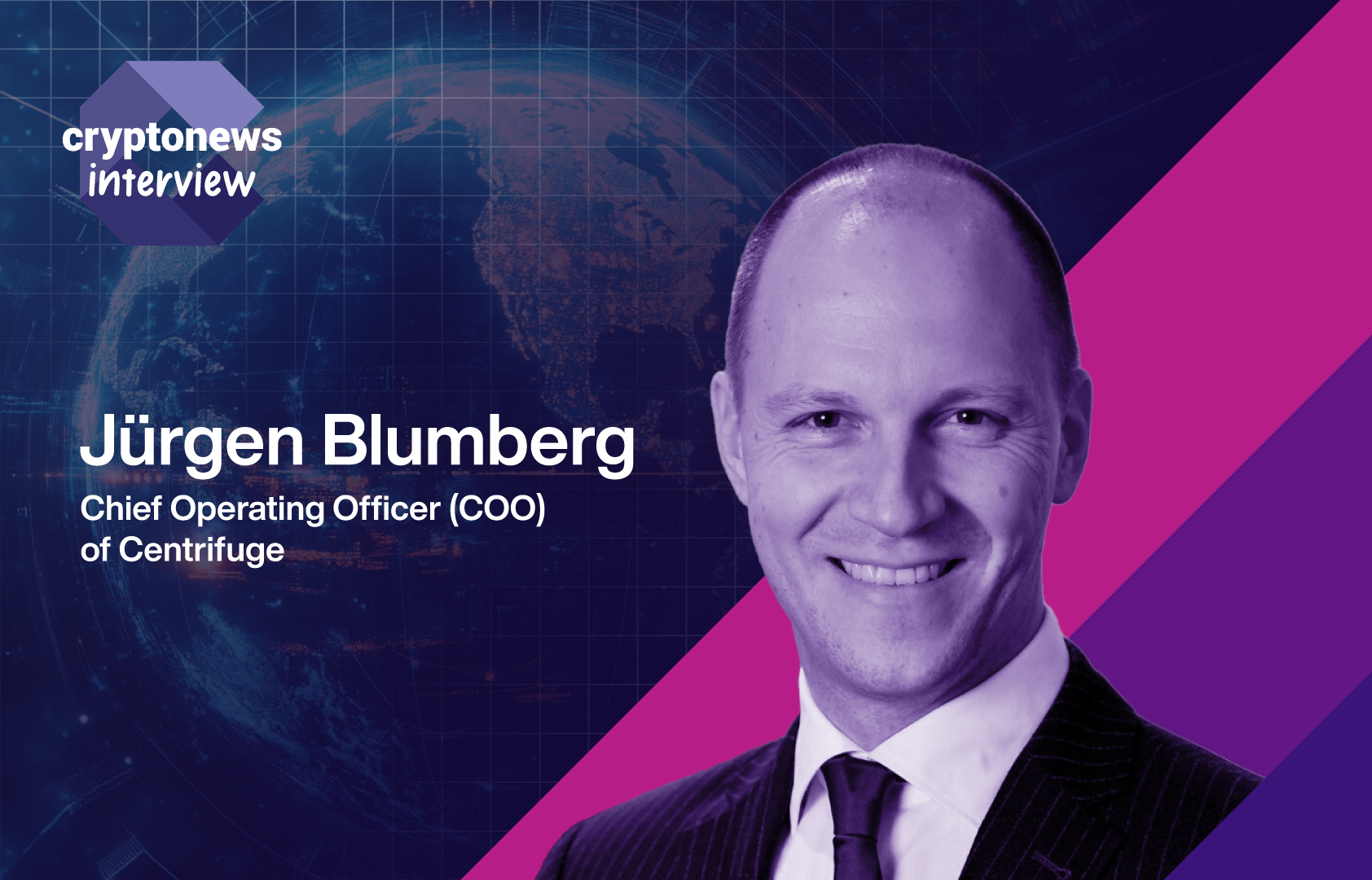
Centrifuge COO Jürgen Blumberg: “DeFi Is Having Its ETF Moment”

Centrifuge COO Jürgen Blumberg: “DeFi Is Having Its ETF Moment”

After more than two decades scaling exchange-traded funds (ETFs) and capital markets businesses at Goldman Sachs, Invesco, and BlackRock, Jürgen Blumberg has joined Centrifuge as chief operating officer. Centrifuge is a DeFi platform for tokenizing real-world assets (RWAs) and using them as collateral in decentralized lending. Blumberg believes the decentralized finance sector is now experiencing a turning point—one that mirrors the transformative rise of ETFs in traditional finance. From ETFs to DeFi Disruption Asked why he chose this moment to leave traditional finance for DeFi, Blumberg frames it in the context of what he calls the industry’s “ETF moment.” He sees clear parallels between the early skepticism around ETFs and the current perceptions of DeFi, noting that both began as disruptive innovations challenging entrenched systems. “I was always fascinated by the markets—how order books work, how instruments exchange on different venues,” Blumberg says. “The first five years of my career were in trading, and then I moved into my first ETF role. Even back then, I was convinced ETFs would replace mutual funds. It took 15 years, but now ETFs as a category are bigger than mutual funds.” He sees parallels between ETFs’ early days and the current DeFi sector : “ETFs were a new technology in traditional finance. Today, DeFi is a completely new ecosystem aiming to disrupt, offering solutions to the cost, time, and access limitations of traditional products. In DeFi, everybody can access markets—24/7.” Clearing Misconceptions About DeFi Blumberg explains that many in traditional finance view DeFi as volatile or risky, but that perception overlooks its structural advantages. “Those who take the time to understand DeFi will see it’s similar to traditional finance—just with different terminology. TVL is the same as AUM, liquidity pools are like exchanges, and derivatives exist on both sides. It’s a fascinating world with the power to disrupt how things are done today.” Tokenization: Not All Tokens Are Equal Recalling an old ETF industry saying—“not every ETF is created equal”—Blumberg applies it to tokenization. The phrase means that while all ETFs fall under the same general category, their structure, risk profile, and quality can vary. “There are tokens that are derivative structures and not fully backed by the underlying asset. Then there are fund tokens, like ours, that are fully backed, giving holders direct access to the assets. Just because something is called a token doesn’t mean it carries the same structure or risk.” Global Regulatory Competition and Centrifuge’s Growth Blumberg also sees regulatory momentum happening worldwide. “At the moment, progress is coming from the U.S. But Europe is moving forward too—Luxembourg is making progress, the EU has MiCA , and many ETP issuers choose Switzerland as their domicile. In Asia, Hong Kong and Singapore are advancing in certain areas. There’s a global competition to attract the smartest ideas and allow controlled innovation.” Centrifuge, he adds, is on the cusp of major progress. “We’re approaching the $1 billion TVL mark. With partnerships such as S&P and others we’ll soon announce, we’re well positioned to keep growing.” ONE. BILLION. DOLLARS. TVL.🔥 The flywheel is spinning. We've been heads down building since 2017, and now our onchain ecosystem has hit its first billion. The first billy was the hardest. The next ones are inevitable. 🚀 Onwards and upwards!!! pic.twitter.com/Ip4pq0qDzY — Centrifuge (@centrifuge) August 12, 2025 For Blumberg, the decisive reason to leave the security of large financial institutions was his conviction that the most meaningful innovation in the next decade will come from startups, not incumbents.

Author: CryptoNews